Why does business resilience need a different approach?
Traditionally business continuity and resilience have been treated as point-in-time, one-off projects, and been fragmented across different teams within an organisation.
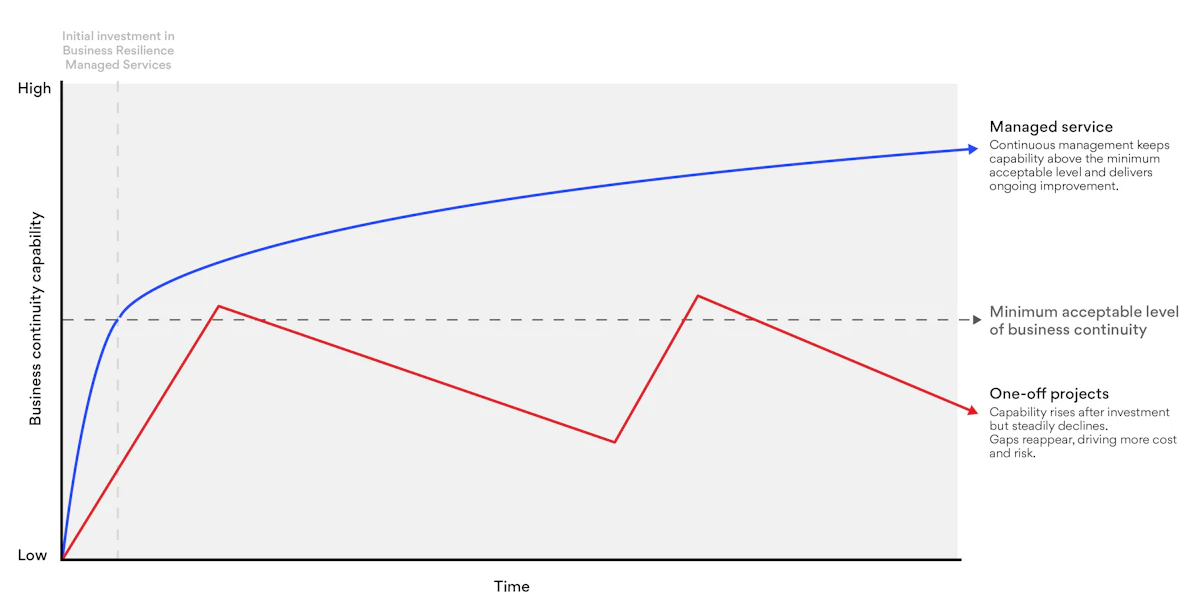
Historically, business continuity produced a series of documents including a Business Impact Analysis (BIA) and a Business Continuity Plan (BCP), followed by an exercise. These were often done in response to an audit or a requirement to win new business and treated as a one-off project. The shortcoming of this approach is that organisations and their risk environments do not stand still. Plans can become outdated as people leave, operations and technology change and new threats emerge.
For many organisations, responsibility is fragmented, – crisis management is owned by one team and incident management by another. IT looks after disaster recovery, while business continuity and information security sit elsewhere. These isolated teams may struggle to work together to respond to and recover from a major cyber attack.
Business resilience is harder to maintain than it once was. Cyber threats are more severe, with the financial and operational cost of disruption increasing. Regulatory requirements are more stringent, requiring evidence beyond just documentation.
An increasing number of regulations and frameworks require organisations to demonstrate effective data protection, resilience and cyber security. This puts greater pressure on businesses that may lack the capacity or expertise to meet these requirements alongside their core work.
Supply chain risk adds further pressure, with customers in regulated industries demanding evidence of business continuity arrangements.
What outcome does a managed service deliver?
When companies adopt a managed service for business resilience, they build the capability to maintain continuity and greater confidence in their ability to respond and recover.
This means their plans are up to date, their teams are prepared and know what to do when disruption occurs.
They embed continuous improvement and resilience into their culture.
They can provide assurance to their boards that they are prepared to respond to disruption. This is evidenced through regular reviews and maturity assessments. They can prepare their leadership through rehearsals.
The commercial value of resilience lies in protecting the organisation’s ability to continue operating through disruption.
When does a managed service make sense?
A managed service makes sense when a company lacks the resources to manage resilience in-house and needs expertise gained across other organisations and incidents.
If you can’t build an in-house team covering crisis management, business continuity and security operations, a managed service can give you access to specialist expertise without recruiting every role internally. Essentially, resilient businesses are protecting revenue, critical customer services and employee livelihoods.
The service provides skills, expertise, service management, capacity and continuous improvement.
Databarracks works with companies that are managing complex regulations in highly regulated sectors that include finance, healthcare and energy. They are managing resilience across fragmented departments and we operate as an extension of their teams, strengthening internal capability, developing practical plans and preparing leaders through rehearsals.