
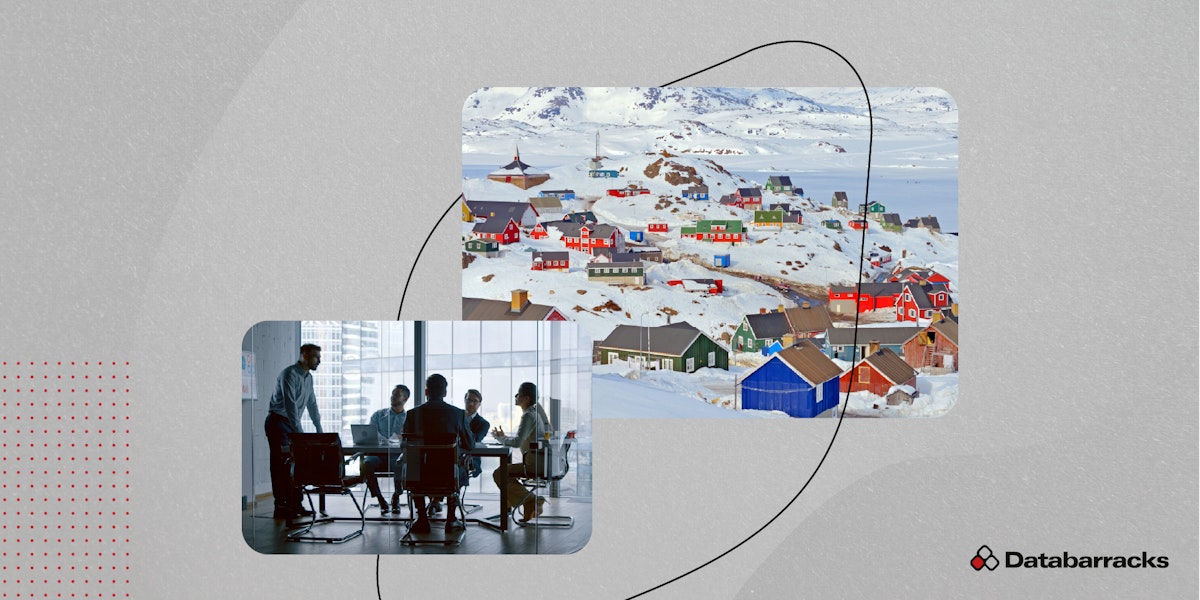
Preparing for the unthinkable: Greenland and global business risk

Databarracks’ Senior Business Resilience Consultant, Simon Freeston, examines the escalating geopolitical tensions around Greenland through the lens of business continuity and what it means for UK organisations.  

A sudden crisis in Greenland 

Greenland is rarely front of mind for UK businesses. But with the US openly discussing annexation as a matter of national security, it has moved sharply into focus. The shockwaves of such a move would ripple through supply chains, trade networks and financial markets. It raises the question: How prepared are UK businesses for disruption on this scale? 

Why Greenland matters 

With a population of just 57,000, Greenland can appear peripheral to global business concerns. But as the largest island in the world – roughly 9 times the size of the UK – it has a strategic significance that far exceeds the size of its population or economy.  

The territory hosts critical US military infrastructure, including Pituffik Space Base, which supports the US Ballistic Missile Early Warning System (BMEWS) and plays a role in monitoring activity across the Arctic and North Atlantic. Greenland also sits close to existing and emerging Arctic shipping routes, such as the Northwest Passage, and is rich in natural resources, including rare earth elements and uranium. 

A sudden annexation by the US would not only challenge international norms and long-standing alliances – it would undermine assumptions of security that many businesses quietly depend on. In today’s interconnected economy, geopolitical disruption rarely stays contained – and what happens in Greenland could very well test the resilience of organisations across the UK.

The business question: Are we prepared? 

The question for UK business is how such a sudden geopolitical shock would be felt across markets and operations, and the likely repercussions – from financial volatility to supply chain disruption and significant strain on the North Atlantic Treaty Organisation (NATO). Businesses must consider how prepared they are for an event that will test the resilience of their systems, partnerships and strategic planning.  

Simon Freeston, Senior Business Resilience Consultant at Databarracks

In today's interconnected economy, geopolitical disruption rarely stays contained

Implications for business continuity 

Market uncertainty  

A US move to annex Greenland would immediately unsettle global financial markets. Stock prices, commodity futures and currency values would likely swing as investors reassess risk. UK businesses with international exposure could face sudden cost increases, changing demand and rising insurance premiums. Even firms not directly linked to the US would feel the ripple effects, as confidence in predictable geopolitical environments erodes. Market uncertainty would test organisations’ ability to absorb the financial shocks and adapt to an uncertain geopolitical landscape. 

Sanctions and supply chain disruption 

Such an event could trigger sanctions, trade restrictions and political divergence between the US and its allies. Businesses relying on American suppliers, technology or logistics would need to identify alternatives quickly or face compliance and operational risks.  

Global supply chains could also be impacted at multiple points, from access to raw materials to manufacturing and distribution logistics. This highlights the importance of ensuring diversity of supply alongside realistic contingency planning to navigate sudden geopolitical disruption.  

Alliance strain 

Alliances such as NATO provide a layer of stability and predictability for global business. Unilateral action by the US would remove that predictability by placing direct strain on alliance relationships. Senior NATO partners have warned that any move on Greenland could severely damage the alliance. Businesses depend on these frameworks to keep shipping lanes open and provide a secure operating environment. Even sustained uncertainty or fragmentation – short of formal collapse – could increase insurance costs, disrupt logistics and complicate long-term planning for UK businesses.  

Resilience beyond assumption 

The Greenland situation highlights an important lesson for UK businesses: the geopolitical status quo, however long-standing, is not immune to disruption. Even the most well-established alliances, historically stable markets and mature supply chains can come under strain. Most organisations quite reasonably plan on the basis of the stability they have known. But risk emerges when those assumptions are treated as guarantees. 

True resilience cannot be purely reactive; it requires anticipating disruptions, building redundancy and preparing for uncertainty as a core business reality. 

For UK organisations, this translates into a need to: 

  • Stress-test business continuity and resilience plans against geopolitical shock scenarios, including sudden alliance breakdowns, sanctions on major trading partners and extreme market volatility that could drive cost increases, supply disruption or insurance pressures.  
  • Identify and reduce single-point dependencies across supply chains, technology and logistics, particularly where reliance on high-risk geographies or partners could create operational compliance exposure under sanctions or trade restrictions. 
  • Build flexibility and decision-making speed into strategic planning, by defining escalation thresholds, alternative suppliers and financial responses in advance, enabling rapid adaptation as cascading risks emerge. 

The future favours organisations that treat uncertainty as a core component of business strategy.  

The test of resilience 

A sudden annexation of Greenland by the US may once have seemed implausible, but recent events in Venezuela and elsewhere have shown how quickly norms can be challenged. 

In an interconnected economy, disruption can spread faster and farther than expected. The test of resilience is whether organisations can absorb shocks, adapt rapidly and continue operating when the assumptions they rely on no longer hold.